
The Sound That Binds: Music Curation in Artisan Bakeries and Food Halls
In artisan bakeries and food halls, music doesn't decorate the space — it defines it. Here's how sound builds brand identity when everything else keeps changing.
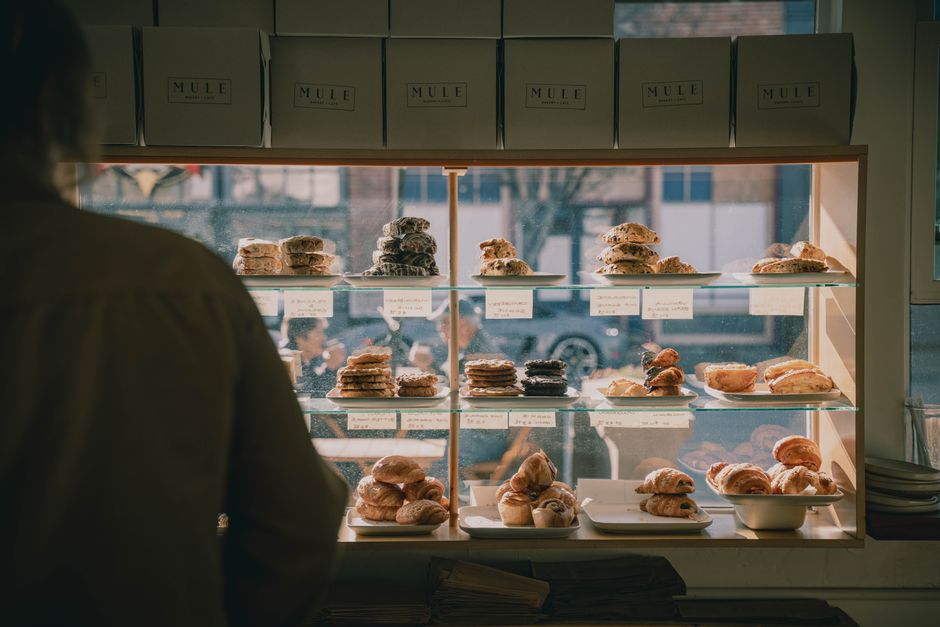
A unique problem: when a space has no single voice
A food hall is not a restaurant. It's not a mall or a traditional market, either. It's a space of permanent tension between dozens of distinct identities competing for the attention of the same visitor, under the same roof. Every stall has its own concept, its own chef, its own story. But the space itself — the air between a display case of butter croissants and a ramen counter — needs a single voice. And that voice, almost always, is music.
The same dynamic plays out, at a different scale, in artisan bakeries. These are businesses competing in a market where experience is the key differentiator. Searches for "unique dessert shop near me" grew more than 100% in the second quarter of 2025, making it clear that consumers are no longer just looking for a good pastry — they're looking for a visit worth making. Sound is an essential part of that promise.
Music as brand glue
In a food hall, the greatest risk is sensory incoherence. Every stall can have its own aroma, its own colors, its own service rhythm. If music doesn't act as a unifying element, visitors perceive the space as chaotic. That perception has direct consequences: in environments with sensory overload, the wrong music can intensify consumer fatigue and speed up departure.
Academic evidence on this has been building for decades. Researcher Ronald Milliman demonstrated as far back as the 1980s that musical tempo in hospitality environments directly affects dwell time and average spend — findings that have been replicated across multiple contexts over four decades. But for today's food halls, tempo is only the starting point. What's at stake is something broader: music's capacity to build an atmosphere that transcends each individual operator and creates a recognizable identity for the space as a whole.
Industry data supports the investment. Strategically curated music can increase per-customer spending by up to 9.1% and dwell time by up to 20%. In a food hall where the business model depends on visitors exploring, sitting down, consuming across multiple stalls, and returning — those percentages are not marginal. They are the difference between a profitable space and one that functions as a passageway.
The Nespresso case and the logic of dayparting
The most instructive parallel for understanding how music works in multi-use spaces doesn't come from the food hall world — it comes from premium consumer retail. MassiveMusic worked with Nespresso to create three playlists — morning, afternoon, and evening — deployed across its 700 global boutiques, all built around a single musical concept defined as "new luxury": fresh, positive, warm, and welcoming. Each playlist has a different tempo and energy, but all belong to the same sonic family.
This dayparting logic applies directly to artisan bakeries and food halls. A food space doesn't live the same moment at 9 in the morning — when the first customers arrive for a coffee and a pastry — as it does at 2 in the afternoon, in the middle of a packed lunch rush, or at 7 in the evening, when visits become more social and unhurried. Music should follow those rhythms without the customer noticing it consciously, but feeling it in how long they choose to stay.
The artisan bakery: a complete sensory stage
Artisan bakeries face an interesting paradox. They are small spaces, almost always carefully designed, where every detail — the typography, the packaging, the wall colors, the way the display cases are lit — has been thought through to communicate a precise brand personality. And yet, music is often the last item on the list, or simply handed off to an algorithm.
That is a strategic mistake. When music doesn't align with brand identity, customers experience the space as incoherent or uncomfortable. The research is consistent on this point: music perceived as ill-fitting for the context is not neutral — it can actively reduce sales compared to playing no music at all. Conversely, when sound and brand proposition are aligned, the space feels authentic and considered.
A bakery positioned as artisanal, with local ingredients and a warm aesthetic, needs a sonic universe that reinforces that promise — not necessarily folk music or mandatory acoustic sets, but music that shares those values of craftsmanship, presence, and attention to detail. A bakery with a French sensibility and visual minimalism needs something entirely different. Sound should be the last element the customer notices, but the first one they feel.
Food halls: from sonic anarchy to spatial signature
The world's most successful food halls have understood that sonic design is part of their value proposition, not an accessory. Places like Union Market in Washington D.C. and Ponce City Market in Atlanta have established themselves as benchmarks precisely by turning the overall space experience into an event, where cultural programming — including music — is part of the offering.
Eataly is perhaps the most studied case in this territory. Its new location in West Palm Beach includes Eataly's first live music stage and culinary programming venue in North America, and its CEO puts it plainly: "This is a story about an experience - an Italian life experience." Sound is not decoration: it's a brand argument. In a model where the space blends full-service restaurants, fast counters, a gourmet market, and a cooking school, music acts as the throughline that gives sensory coherence to all that diversity.
The concept of a "sonic hero track" — a melody or sonic family that becomes synonymous with the space — is especially relevant here. That distinctive sound, played in key areas and present across digital communications, generates emotional recall and reinforces the identity of the place beyond the physical visit. It's what separates a memorable food hall from one that simply works.
Designing the sound before opening day
The most common mistake in artisan bakeries and food halls isn't choosing the wrong music — it's not choosing at all. Letting an algorithm or a generic playlist fill the space is the equivalent of leaving the walls unpainted. It technically works, but it wastes one of the most powerful tools available for communicating who you are.
Designing a sonic identity for these spaces means answering a few questions before opening the doors:
- What emotion should the space produce in the first 30 seconds of a visit? Music is the first stimulus to arrive before the customer has seen the display case or tasted anything.
- How does that goal shift depending on the time of day? The same space may need calm energy in the morning and a more social frequency in the afternoon.
- How well does the music align with the rest of the brand decisions? If the packaging is minimalist and the music is loud and festive, there is a disconnect the customer will perceive even if they can't name it.
- Who updates and maintains that selection over time? Music curation is not a one-time project — it's a living system.
For spaces operating at this level of complexity — multiple zones, multiple concepts, audience flows that shift throughout the day — specialized human curation makes the difference. That is exactly the kind of challenge that services like Mystify Radio are built to address: designing custom stations that maintain brand coherence over time, adjusting the sound to the rhythms of the space without sacrificing identity.
In a market where consumers are increasingly choosing physical spaces precisely because they offer something e-commerce cannot replicate — full sensory immersion — sound stops being an operational detail and becomes a strategic decision. The artisan bakeries and food halls that understand this first will have an advantage that doesn't appear on any menu, but is felt in every minute the customer chooses to stay.
CEO and founder of Mystify Radio. Music curator for 100+ venues across LATAM. Specialist in audio branding and sonic identity.
About PauloWhat people ask us
Why is music especially important in food halls compared to other retail spaces?
Food halls face a unique challenge: dozens of distinct stalls compete for attention under one roof, creating constant sensory tension. Without music acting as a unifying element, visitors perceive the overall space as chaotic, which can intensify consumer fatigue and accelerate departure. Music serves as the single shared voice that gives the space a coherent identity beyond any individual operator.
How much can strategic music curation actually increase sales and dwell time?
According to industry data cited in the article, strategically curated music can increase per-customer spending by up to 9.1% and dwell time by up to 20%. Researcher Ronald Milliman demonstrated as far back as the 1980s that musical tempo in hospitality environments directly affects both metrics, findings that have been replicated across multiple contexts over four decades. In a food hall model where revenue depends on visitors exploring and consuming across multiple stalls, those percentages represent the difference between a profitable space and one that functions as a passageway.
What is dayparting in music curation and how does it apply to bakeries and food halls?
Dayparting means designing distinct playlists for different moments of the day, each with its own tempo and energy while belonging to the same sonic family. The article uses Nespresso as a reference: MassiveMusic built three playlists -- morning, afternoon, and evening -- deployed across 700 global boutiques, all rooted in a single concept defined as new luxury. Applied to a bakery or food hall, this means the music at 9 a.m. during a quiet coffee visit sounds and feels different from the music at 2 p.m. during a packed lunch rush or at 7 p.m. when visits turn more social and unhurried.
What happens when the music in an artisan bakery does not match its brand identity?
The article is direct on this point: music perceived as ill-fitting for the context is not neutral -- it can actively reduce sales compared to playing no music at all. Customers experience the space as incoherent or uncomfortable, even if they cannot articulate exactly why. Conversely, when sound and brand proposition are aligned, the space feels authentic and considered, reinforcing the overall promise the business is making.
What is a sonic hero track and why does it matter for food halls?
A sonic hero track is a melody or sonic family that becomes synonymous with a specific space, played in key areas and present across digital communications. The article argues it generates emotional recall and reinforces the identity of the place beyond the physical visit itself. It is described as what separates a memorable food hall from one that simply works, making it a brand asset rather than just background sound.
What is the most common mistake artisan bakeries and food halls make with their music strategy?
According to the article, the most common mistake is not choosing at all -- letting an algorithm or a generic playlist fill the space. This is compared to leaving the walls unpainted: it technically works, but wastes one of the most powerful tools available for communicating brand identity. The article recommends designing sonic identity before opening day by answering questions about the emotion the space should produce, how that goal shifts by time of day, and who will maintain and update the selection over time.
Get the next article
Once every two weeks. No spam, only what is worth reading.